Creating employee handbook – best practices
When you unbox a shiny new smartphone, struggle with IKEA furniture, or help your kids build a Lego castle, you naturally reach for the instructions. Your company deserves that same level of clarity - and that is exactly where the employee handbook comes into play. Presented in a clear, accessible format, for example with a flipbook maker, it becomes easy to read, navigate, and actually use.
In the sections below, we explain the core purpose of an employee handbook and why it is vital for your organization.
What is an employee handbook?
An employee handbook is a document that describes everything employees need to know: company policies, daily procedures, job expectations, benefits offered, as well as rights and responsibilities. In practice, you'll find answers to questions you're too embarrassed to ask your boss (or forgot to ask during onboarding). For example:
- Explaining anti-discrimination policies - which can be very important when opening an office in a new country with different mentalities and customs.
- Outlining technicalities - how to use the access card, how to log into the system, and where to get all those "tickets" so work can actually start.
- Describing what determines, for example, a salesperson's compensation - base salary, commission, bonuses, and allowances.
- Indicating the most important place in the office - the cafeteria location and rules for using it (e.g., sharing the fridge).
It's essentially "one source" that helps people understand how to do their job well, fit into company culture, and act in accordance with the law. When an experienced colleague is not around to help, the company manual can truly save the day.
Most companies provide this document during onboarding – in printed brochure form, digitally as a PDF, or shared as a link. Below is an example of what an employee handbook can look like when built with Publuu.
Publuu’s employee handbook example
How to create an effective employee handbook step-by-step
Creating a professional employee handbook is a complex project that combines legal compliance, organizational culture, and internal communication. It's not something one person should write alone at their desk drinking coffee after coffee. Here's a proven, comprehensive approach:
Build a team of multidisciplinary experts
Don't write the handbook in isolation. To be practical and "useful in real life", you need input from many perspectives:
- HR: Knows the most common employee questions and recurring "problems" during onboarding. They know which sections will be most frequently visited.
- Legal / Compliance: Ensures compliance with Labor Code and GDPR.
- Management / Executive team: Sets tone, vision, and strategic priorities.
- Marketing / Employer branding: Maintains consistency of language and visual style with employer brand (communication tone).
- Employee representatives: Unions or works council. Their input prevents "they came up with something again from above" reaction and speeds document acceptance.
Legal audit - respect the hierarchy of rules
Remember the hierarchy of legal sources: national Labor Code → collective labor agreements → work regulations → employee handbook.
- Golden rule: The handbook cannot offer employees less than what the law guarantees (e.g., Labor Code). If law mandates 20 days vacation... well, you can't take it away.
- Multilingual access: If you employ foreigners, good practice is to provide the handbook in a language understandable to the employee.
- Local versions: If you have offices in multiple countries, forget one universal handbook. Create a global "core" (common values, universal standards) and attach local annexes with country-specific regulations. For example, in France lunch breaks are regulated, and in Germany vacation rules differ from Polish ones.

Planning and writing - human-centered approach
Write in language of benefits and clarity – not prohibitions. Avoid legal jargon. For each policy use a simple 3W scheme:
⭐ Why? Explain the intention.
Example: "We believe in work-life balance and the right to disconnect after work, because your private life is as important as your company duties."
⭐ What? Give the rule.
Example: "...so we don't expect you to answer emails after 5:00 PM."
⭐ How? Give practical procedure.
Example: "...if you send an email in the evening, use the 'schedule send' function for the next morning."
Consultation and approval
Before you share the handbook with everyone, take three key steps:
- Check GDPR compliance: Make sure there are no unnecessary privacy violations – e.g., if you monitor all messages on company phones... that's a step too far.
- Consult with employees: Share the draft with team representatives. This prevents "top-down" negative reaction and makes people more willing to follow rules.
- Get management approval: Without this, the handbook isn't an official document, just a cool project.

Smart distribution (not just email attachment)
Sending a message with a long, overly technical title almost guarantees it will end up in the "Received" folder and never get opened. Instead:
- Share the handbook during pre-boarding, before the employee appears in the office. This way they won't have to ask about everything on the first day, and you'll look like a very organized employer.
- Place QR codes in strategic places: in the kitchen, conference rooms, at the entrance. When an employee asks "how do I apply for vacation", they can simply scan the code and immediately find the answer.
- Get electronic confirmation that the employee familiarized themselves with the handbook. This is as good as paper forms that HR can lose.
Handbook as a living document: updates and archiving
The worst handbook is the one that hasn’t been updated for a long time. For example It still shows the old logo and pay details from years ago.
- Regular reviews: Review at least once a year and every time the law changes (e.g., new leave entitlements, minimum wage updates).
- Change tracking: Instead of sending an entire new handbook version, send employees a short summary of changes. Nobody wants to read 50 pages again to learn the payment date changed by one day. Tools like Publuu make this effortless by letting you update the document without changing the link – so employees always have access to the latest version.
- Archiving: Essential in legal disputes. You must be able to prove which version was in effect on the specific date. Keep a record of all versions, along with their effective dates, for as long as employee claims can be filed (for example, 3 years).
Best practices and common mistakes to avoid in employee handbooks
An employee handbook should be something people actually use, not a document that gets written once and then forgotten. Based on real experience, here are some practices that work well, along with the mistakes companies make most often.
Best practices
- Involve employees in the creation process – "front-line" people will instantly point out rules that are unclear, unrealistic or just out of date.
- Place handbook in cloud with permanent link – one update and everyone has the latest version.
- A few check questions after each chapter help people remember key information.
- You can even add a touch of humor – e.g., light, funny graphics / memes for wrong answers.
- Version with effective date on cover (crucial in disputes).
- Separate "Global Handbook" (culture, values) from local annexes (Poland – 26 days vacation, Germany – works council, etc.).
Most common mistakes
- Copying from another company's handbook (may cause problems if the rules conflict with local labor law).
- 80-page PDF in 10-point font sent once during onboarding and never again.
- Writing "we're like family", then reducing staff (Netflix solved this by writing "we're a team, not a family").
- Promising benefits the company can't deliver ("unlimited vacation" that nobody actually takes in practice).
- No signed / digital confirmation – then in court the employee says "I never saw this".
Turning your employee handbook into a usable digital tool
Now that you know how to create an employee handbook, it’s time to think about how to make it truly usable.
Most of the mistakes above don’t happen because companies have bad intentions. They happen because the employee handbook is treated as a static PDF instead of a living document that people actually interact with. Choosing the right digital format makes a real difference here.
Publuu transforms your boring PDFs into interactive flipbooks that people actually want to browse. It's a combination of printed brochure elegance with digital tools.
✔️Multimedia that attracts attention: Insert video from CEO (they'll finally see them!), GIFs, and links to important procedures.
✔️Password protection: Because what happens in the company should stay in the company. Well, unless it's about success – then you can brag.
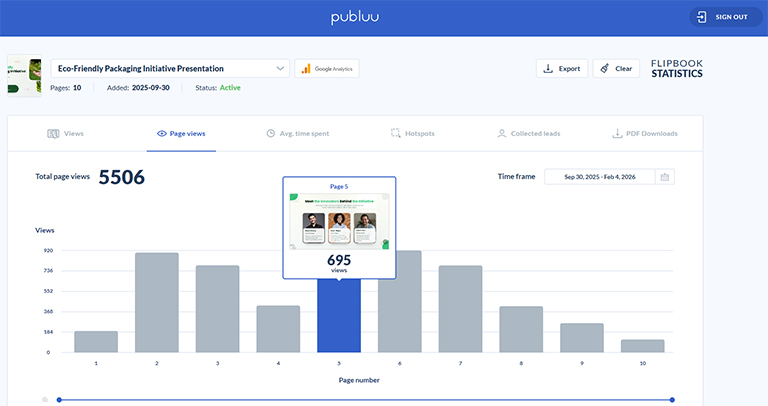
✔️Analytics: Check whether employees actually read about GDPR or immediately skip to the chapter on benefits.
Writing clearly - how to make your employee handbook readable
Even the best legally crafted handbook is useless if nobody opens it. For employees to actually use it, it's worth caring about readability and form as much as content. Apply the following steps:
✔️ Use "you" form: Address the reader directly. Instead of: "Employees are required to submit leave applications...", write: "Submit your leave application at least 7 days before planned absence".
✔️ Make it easy to read: Use short paragraphs, bullet points, and lots of white space. Large text blocks are difficult to read. 12-point font, Times New Roman or Arial. Avoid unnecessary extras – focus on content.
✔️ Speak clearly: Unless it's industry terminology everyone knows, stick to simple language. If you must use an acronym, define it first. For example: "In our company we apply GDPR (General Data Protection Regulation), which protects your personal data".
✔️ Be consistent: Stick to one tone – whether formal, casual, or humorous. If you're building a relaxed, friendly culture day-to-day, don't create a handbook that sounds like a criminal code.
✔️ Visualize data: Don't write a paragraph about organizational structure; show a chart. Don't list holiday schedules in a sentence; use a calendar graphic.
Traditional vs. digital employee handbook formats
Choosing handbook format is like deciding between sending a carrier pigeon vs. email. Both (theoretically) work, but one is clearly outdated.
| Feature | Traditional (print) | Digital (online / PDF) |
| Accessibility | Physical copy required | Available anywhere, anytime |
| Updates | Requires reprinting and redistribution | Easy to update; employees always see current version |
| Searchability | Manual page flipping | Instant keyword search |
| Cost | Printing and distribution costs | Minimal ongoing costs |
| Environmental impact | Paper consumption | More sustainable |
| Engagement | May feel formal and authoritative | Can include video, links, interactive elements |
| Tracking | Manual collection of acknowledgments | Automatic tracking of who read what |
| Best for | Workplaces without computer access; backup copies | Most modern workplaces; remote teams |
Digital format is like a new smartphone – flexible, always at hand, and has lots of useful features you didn't know you needed. Traditional print is like an old phone with T9 keyboard – works, but only in very specific situations. Best to have it as backup, not as main tool.
Why is an employee handbook important for companies?
In a tiny team, a newbie can just yell, "Hey Boss, how do I turn this thing on?" But for any growing organization, a handbook is essential. It builds consistency, ensures transparency, and, crucially, stops legal headaches before they start.
Presents culture, mission, and values
From day one, the handbook welcomes the employee to the "tribe". When people understand the mission, they engage better. Plus, a good handbook prevents the "new kid" stress. Instead of searching for help or feeling lost, they can focus on their responsibilities.
Often the design of the handbook itself can help an employee understand the company better. Bright colors and infographics might suit an education company, while a sleek, minimalist cover works for a tech firm.
Sets clear expectations
The handbook precisely defines behavioral rules, performance standards, and key processes – from submitting vacation requests to safety procedures. Thanks to this, everyone plays by the same rules, and policies are enforced uniformly throughout the company. Even if certain matters are regulated by your country's law, it's worth reminding them in the handbook – for certainty and peace of mind. HR data suggests, employees with a clear understanding of their responsibilities are 53% more productive than those left guessing what is expected of them.
Health and safety training is mandatory, but the handbook can describe basic rules for functioning in the company. You can work at an engine manufacturing company as a salesperson: but you should still know how they work and how to maintain safety on the production floor. In a healthy organization, everyone should know how the whole machine works (so they don't accidentally break it).
Describes management practices
What does communication look like in the company? When will I receive my paycheck? What are the scheduling rules and what do I do when I want to take vacation? This staff manual answers these questions, covering issues such as family / medical leave, civic duties, and other leave policies.
Even if the law in a given matter is quite strict, the handbook can precisely specify company standards (e.g., payment on the 15th of the month, not "around the end of the month").
Ensures policy consistency
Without a handbook, we risk different managers applying different standards, which leads to misunderstandings. Written rules eliminate this problem, ensuring equality and transparency. This is also a reason to share the updated handbook with experienced employees.
Performance review systems are a good example – the handbook can explain that while monthly reviews are crucial, additional training can positively impact the final evaluation.
Highlights benefits and perks
People want to know what they're getting. The handbook describes in detail paid time off, health insurance, retirement plans, and any other benefits offered – which directly impacts employee satisfaction and retention. Is there a gym, a drink vending machine, or maybe you're not allowed to bring your own tea? Small stuff are more important day-to-day than they might seem.
If you're planning bonuses for top-performing employees, such as the ability to use a company laptop for personal purposes, you can include this in the handbook, which will specify what can be done with the equipment.
Promotes legal compliance
Federal and state regulations require employers to provide employees with certain information. Maintaining a corporate handbook help meet these requirements, reducing your legal liability.
Having a signed acknowledgment form is your shield. It proves the employee was informed, which is invaluable if a dispute ever lands on a lawyer's desk.
What should be included in an employee handbook?
A good handbook does not have to be a hundred pages long. Its main job is to translate dry legal rules into plain language that everyone can actually understand. Since it is meant to help your team, focus on the things they really need to know to do their jobs well.
Welcome and company culture
Start with a quick introduction to show what your company stands for. Mention your mission and values, and show the team structure so new people know who is who. This is also the best place to talk about your commitment to a respectful and inclusive workplace.
Workplace rules and conduct
Clearly explain what you expect from employees in terms of behavior. This includes basic standards of professionalism, anti-bullying policies, and dress code. You should also mention how to handle social media and how to report any conflicts of interest.
Pay, benefits, and time off
This is the part everyone reads first. Be clear about when paychecks arrive and how bonuses work. You should also explain your vacation policy, how to request days off, and what extra perks like health insurance you offer.
Legal policies and safety
Every organization needs a section on legal requirements. Cover the basics of data protection and workplace safety. It is also a good idea to confirm your policy on after-hours communication, as many regions now recognize the right to disconnect as a standard practice.
Remote work and confirmation
If your team works from home, set clear rules on equipment and costs. For example, some regulations, like the California Labor Code, require employers to reimburse employees for necessary business expenses. To finish, always include a form where the employee confirms they have read the document to ensure the rules were properly communicated.

Employee handbook FAQ
How often should we update the handbook?
Once a year is the absolute minimum. Additionally – always when regulations change (e.g., leave or minimum wage). Instead of sending everything again, send employees a short list of changes.
Give one permanent link (e.g., on Slack) and post QR codes in the office – preferably in the kitchen or elevator, where people take out their phones anyway. New employees should receive it by email 3 days before starting.
How to ensure employees read the handbook?
Instead of "wall of text", throw in videos and graphics. For legal peace of mind, require digital acknowledgment of receipt. You can also add a short, fun quiz at the end – it's the best way to check whether the most important rules stuck in memory
Conclusion on employee handbook
A great employee handbook isn't an HR obligation - it’s a key part of your company culture. It's the first and last document showing whether you really care about people or just want to legally protect yourself.
When it's written in human language, looks beautiful, lives in the cloud, and evolves with the company – employees actually read it, proudly show it to friends ("look how cool my company is"), and you sleep peacefully knowing that in case of dispute you have indisputable proof that everyone knew the rules.
You may be also interested in:
How to create a URL link to a PDF document?
Employee newsletter: comprehensive guide
Employee training manual – what is it and how to create it?