How to increase customer engagement with interactive publications
Let's be honest: at this point, everyone knows that a lead magnet is basically standard in marketing. People love getting something for free, an ebook, a game, anything, before they decide to join a newsletter. I've signed up for plenty myself, thinking "I'll unsubscribe if it's boring". But when the newsletter is actually good, I end up staying.
Digital publications that attract and keep customers are quickly becoming the norm. So the real question is: how do you make yours stand out from the rest?
The solution is an HTML5 flipbook that lets you turn a boring PDF into an interactive digital catalog. In this article, you'll learn what the customer engagement is, what do to and what not to do when creating interactive magazines and publications. Ready? Let's begin.
Keep in mind
- Don't treat interactive flipbooks as just another type of a PDF. Use hotspots and multimedia to make your document unique.
- Balance your multimedia content; avoid overloading readers and focus on the mobile-friendly approach.
- Use built-in analytics to track metrics and improve your strategy.
What is customer engagement?
Good marketing isn't just about grabbing attention – it's about giving people a reason to care. You can't judge a product if you don't interact with it, just like you wouldn't know whether a frozen pizza is good unless you actually look at the box or check the price.
That's the essence of customer engagement: guiding someone from "I'm curious" to "I like this", then "I trust this", and eventually "I'm recommending this". And the thing that drives that journey is engaging, interactive content.
Whenever I get a catalog for a new game bundle, I dive in because I'm genuinely interested. If I can click trailers, watch gameplay, compare DLCs, and check prices, I'm far more invested than if I only saw a simple "new FPS" label. The more I explore, the more hooked I get – and the more likely I am to buy. That's customer engagement in action.
Why interactive publications engage customers
Content matters – but how you present it matters just as much. People respond to technology that feels helpful, intuitive, or simply cool. A plain PDF is fine, but browsing an ebook or catalog online, clicking through pages, watching videos, or opening links feels far more engaging – almost like flipping through a real book.
And it's more than just looking great. Interactive content makes people participate actively, which helps them remember information better and connect with it emotionally. Nobody enjoys being forced to watch a long video, but when you let them explore at their own pace, their interest grows naturally.
It's also incredibly convenient: everything is in one place – videos, images, product details, even an "add to cart" button. And for you as the seller, it's the perfect moment to reach someone right when their curiosity is at its peak.
Oh, and what's more, interactive publications are measurable. You can see not only how many people were interested, but also which pages caught their attention the most.
5 Ways to boost customer engagement with interactive flipbooks
1. Add images, videos, and audio
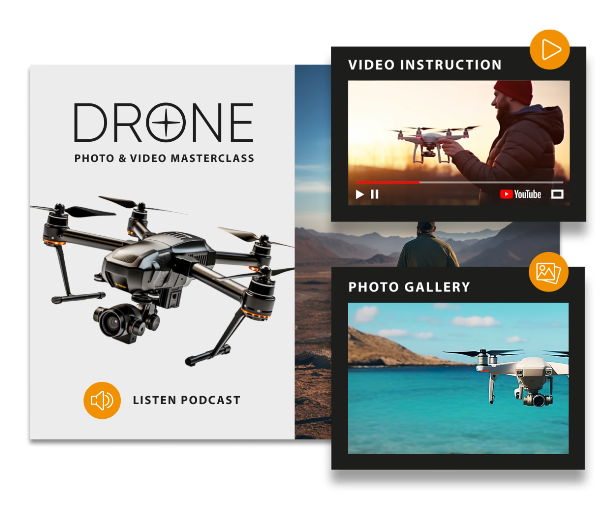
Multimedia is a huge part of modern marketing. Many people, especially Gen Z and Gen Alpha, though not only them, prefer watching a quick video over reading a long article. We're visual creatures, and good images make information easier to understand.
But there's one rule: the illustrations have to be meaningful. Stock photos can work, but real product photos or real customers using your service feel far more authentic (with permission, of course).
Think about adding real value. A real‑estate agency could include a virtual tour instead of just static photos. A fitness brand could add short demo clips for each exercise in a workout guide. These small additions make the content more useful and more engaging.
2. Guide readers with clickable links and clear calls to action
Marketing isn't just about showing a product – it's about guiding people toward what they should do next. A good call to action turns "here's some information" into "here's your next step". That might mean buying a game, grabbing the soundtrack, adding something to the cart, or downloading a DLC, depending on what you highlight in your CTA.
Use benefit‑focused language. For example, "Book your room, skip the wait" is far more appealing than a generic "Click here".
At the same time, customers don't like being overwhelmed with instructions. Stick to one main call to action per page. Don't throw "buy now, read reviews, learn more" at them all at once – too many choices make people freeze and do nothing.
3. Strengthen your brand with a custom domain
Which link is easier to remember: bestgames.com/offers or platform.thirdparty.com/user/id/2222? Branded links make a difference – they are more secure, feel more trustworthy, and are easier to share.
A custom domain (instead of a long, generic third‑party URL) builds credibility, strengthens your brand and keeps everything consistent. With tools like Publuu, you can set up your own domain or subdomain and create short, branded links to specific pages in your publication – no technical skills needed.
4. Generate leads with forms and wish lists
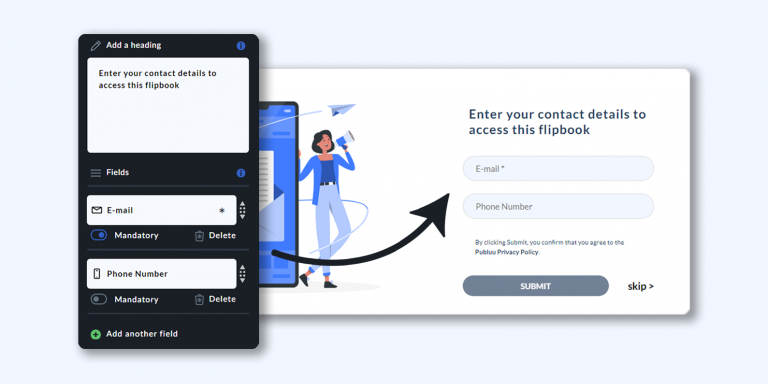
If you're using your flipbook as a lead magnet, make signing up as simple as possible. Publuu's lead forms let people leave their email right inside the flipbook, without sending them to a separate landing page. For example, if you're sharing a recipe ebook, you could add a small prompt after page five: "Want the rest? Leave your email and I'll send you the full version plus weekly recipes". Keep it easy – most of the time, just an email address is enough. And of course, make sure you follow GDPR or your local privacy rules.
Benefit‑focused wording works best. "Subscribe for more free ebooks and exclusive discounts!" will always get more attention than a plain "Sign up for our newsletter".
5. Reach customers across different channels
Even the best flipbook won't drive engagement if nobody sees it. Your publication needs to live in different places – don't rely only on newsletters. Publuu makes it easy to share flipbooks in emails, on social media, or embed them directly on your website.
QR codes are also a great option. You can add them to event flyers that link to your full online catalog, or place one on a restaurant menu stand that leads to seasonal specials. They also help you understand where your readers are coming from. QR‑based marketing gives you something traditional print never could: measurable, trackable engagement from offline channels.
How the interactive publications boost costumer journey
Every feature we mentioned has its own role. You can use content at any point in the customer journey, depending on what you need. Maybe you want to keep loyal customers engaged, or maybe you're trying to give unsure buyers a final push.
The customer journey usually has five stages:
- awareness,
- consideration,
- decision,
- retention,
- advocacy.
When you match each stage with the right content, people feel understood – and you're much more likely to reach them.
Awareness
For now, focus on understanding your audience rather than moving towards direct sales. Use interactive magazines, or small publications to show what you offer. For example, a comic store could release a short digital zine with reviews, upcoming titles, and a few indie comics. People enjoy it, remember the brand, and come back later.
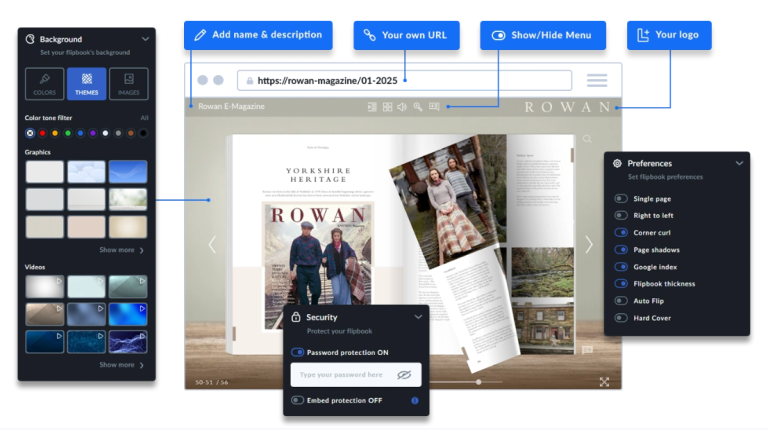
Memes and infographics work well too – and Publuu lets you add custom branding such as for example background, or a name and description to anything you share. Even seeing your logo regularly helps build recognition. Good content positions you as the person who knows, and that kind of authority builds trust fast.
Consideration (comparing options)
In the consideration stage, people want proof and details: comparisons, reviews, case studies, demos. Your ebook's job here is to actually help people decide, not just promote your product.
A good catalog works like a guide – and with Publuu, readers can jump to your store with a single click.
Decision
At the decision stage, a well-designed interactive flipbook can make it easier for the reader to act on their interest. This does not have to mean a basic “BUY” button.
Depending on your sales process, you could include discount links, coupons, quote-request forms, anything that reduces friction and make purchasing easier. Publuu, for example, lets you embed forms right on any page, and tag products with discounts that link straight to checkout.
Retention
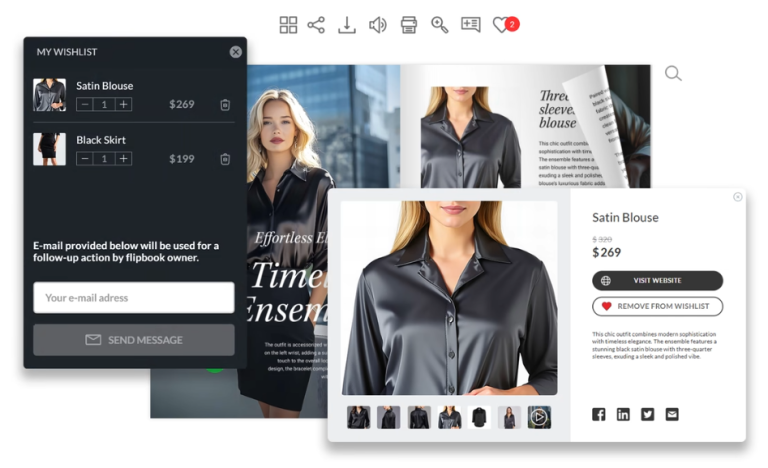
After purchasing a product, what matters most to the customer? The user manual. With Publuu, you can turn it into an interactive guide with video demos, product labels, and even a wishlist button for favourite items. You can also add a short how‑to section or extra ideas for more advanced users.
How to measure customer engagement
One of the great strengths of digital marketing is its measurability. Unlike a printed brochure or poster, you can see and plan how many people viewed your publication, clicked a link, what happened next, and even which pages of your content they read. By tracking these metrics you can continuously refine your strategy and identify what needs improvement.
Key metrics
- Time on page – Is your content actually holding attention?
- Click-through rate (CTR) – Are people clicking your links and CTAs?
- Video plays – Is anyone actually watching your embedded videos?
- Form submissions / conversions – Are people taking the action you want?
Publuu's built-in analytics can provide these numbers, and from them you can begin building hypotheses about what works. Remember, though, that the goal is genuine insight — not confirmation of whatever you already believed going in.
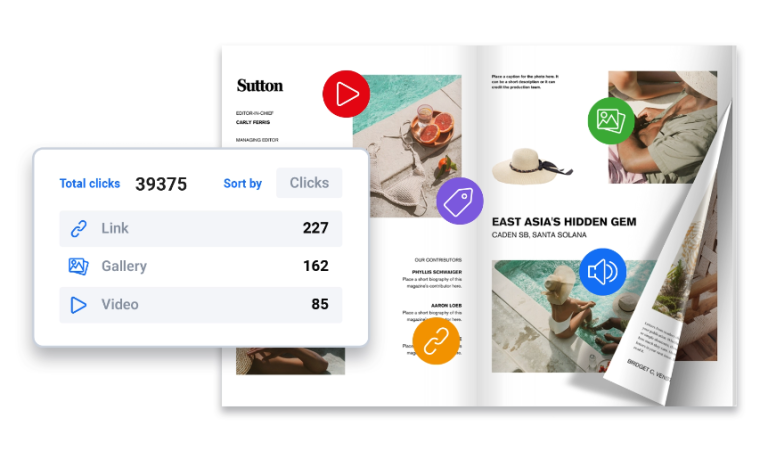
In addition, don't worry about every small rise or drop in your stats. Instead, think about user personas – simple profiles that represent your typical customers. They help you see real patterns instead of reacting to random changes. For example, if your catalog gets lots of views but very few clicks, it probably doesn't mean people aren't interested. More likely, your call‑to‑action is hard to notice or your product descriptions aren't clear enough.
Many companies focus only on the final content and forget to look at how people actually behave. Good personas show you what your customers really need – and how those needs change over time.
Take Affinity, the design software from Serif. It was created as a pro‑level alternative to Photoshop, Illustrator, and InDesign. But because it's easy to use and has a one‑time purchase price, it also attracted many hobbyists and beginners. That unexpected audience became an important part of their strategy.
Over time, the company shifted toward this wider audience. Canva bought Serif in 2024, and by October 2025 the new Affinity Studio was relaunched as a free, combined creative tool for photo editing, vector design, and page layout. It's a clear example of a company paying attention to who uses its product – and adjusting when the audience changes.
Common mistakes that reduce reader engagement
Many people simply publish their content and wait for results. But a finished publication still needs ongoing work.
Do not treat flipbooks as just another version of a PDF
Many creators treat flipbooks like slightly fancier PDFs – and that's where things go wrong. Even if some features feel unnecessary, it's worth using basics like internal links, hotspots, and clear clickable navigation. These small touches make a big difference for retention. If issue one of your magazine is easy to browse, people are far more likely to come back for issue two.
Do not overload readers with multimedia

Too much multimedia can turn readers off. For example, if you add background music and forget about it, then autoplay a podcast on top of that, it becomes confusing and breaks basic accessibility rules. It can frustrate both people with disabilities and regular users. Keep things simple: one interaction per spread. Give readers one clear thing to click or watch, instead of a messy mix of media competing for attention.
Do not forget mobile optimization
Don't forget about mobile users. More than 60% of web traffic now comes from phones, and no one wants to pinch‑zoom a huge PDF on a small screen. Take a moment to check how your flipbook looks on mobile – text size, layout, buttons, everything. A few small adjustments can make it much easier to read.
Interactive publications FAQ
What kinds of content can be turned into interactive publications?
Almost any page-based material works well: catalogs, brochures, lookbooks, annual reports, menus, and training guides. Interactive publications work best when readers want to explore details and discover information at their own pace.
Usually, yes. Publuu lets you replace the source file or update links without changing the original publication URL. This is great for things like price updates, new magazine issues, or offers that have expired.
Yes! Most platforms let you use password protection, hidden links, or other access controls. These are great for things like internal training materials or confidential B2B offers.
You may be also interested in:
How to increase traffic to your website: 10 proven ways
What is a digital engagement – a complete guide
What is engaging content and how to create it effectively